Marker-less Head Tracking with LPVISION

For our LPVIZ in-vehicle AR system we usually rely on outside-in tracking systems like the ART Smarttrack 3. These camera systems work very well and deliver almost optimum performance for the use-case, especially if they have an interference filter built-in to protect from the influence sunlight. At the same time they are relatively large and require some effort to install.

Therefore for quick and easy prototyping, we started exploring markerless head tracking as alternative to marker-based outside-in tracking. The LPVISION head pose tracker is the result: an advanced 6DOF system that uses a standard RGB camera and machine learning alorithms for accurately following the head pose of a user wearing an AR headset.
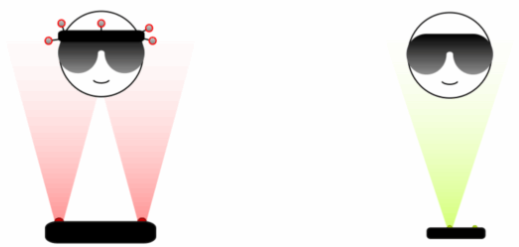
The diagram above shows the difference between marker-based (left) and marker-less (right) head tracking setups. Note that for the markerless tracking setup only a single camera and no markers attached to the headset are required.

Key Advantages

Markerless operation via facial landmark detection: The system utilizes AI-powered facial landmark detection and other computer vision techniques to track head orientation and position continuously. Because of this, there are no rigid bodies, no reflective markers, and no physical contact with tracking gear required. Ultimately, this creates a non-intrusive experience.

Single RGB camera replaces multi-camera setups: We have replaced multi-camera IR setups with a single, compact RGB camera – such as the Stereolabs ZED camera line (note that even though the ZED camera is a stereo camera we use only one of the the built-in cameras). Therefore, this dramatically reduces hardware cost and physical setup complexity, while maintaining the precision required for industrial and spatial computing applications.

Zero-contact setup and instant deployment: You can go from zero to tracking instantly. In fact, there is no room-scale calibration, no physical mounting of tracking gear on the user, and no warm-up procedure needed. Consequently, the natural user experience means deployment in the field is as simple as launching the software.

Optimal for vehicle-in-the-loop and cockpit environments: Unlike stationary IR camera arrays, this tracker is engineered for dynamic environments. Particularly, it is optimal for vehicle-in-the-loop (ViL) testing and flight cockpit applications – scenarios where traditional IR-based systems are difficult to setup due to limited space and dynamic lighting conditions.

Integration with the LPVIZ In-car AR Solution

The LPVISION head tracker is designed to act as a drop-in replacement for complex IR-based tracking setups. For users of our LPVIZ platform it is a light-weight, easy-to-install alternative to our regular proven Smarttrack 3 setup. The video below shows a test drive with the system. The tracking camera itself isn’t visible in the video. It shows the view of the camera including the detected coordinate frame on the left. The window on the right shows a simple demo scene that’s being displayed to the user wearing the headset. As the car moves foward the viewpoint in the scene moves in the same way. Direction and offset to the location of the car is controlled by the output of the markerless head tracking.

Conclusion

We successfully implemented a markerless head tracker that works with users wearing an augmented reality HMD like the Xreal Air 2 Ultra. While the solution is easy to set up and use, we were not able to reach the levels of accuracy achieved by marker-based outside-in tracking. Unsolved problems like detection failures when more than one person is in the field of view of the tracking camera remain.

In conclusion, the LPVISION head tracker system is great for prototyping and quick installations, but for applications where accuracy and reliability is essential we found that a traditional outside-in system like an ART Smarttrack 3 is the preferred solution.

We will add a quantitative comparison chart between LPVISION markerless head tracking and marker based ART tracking soon!
Strategic Partnership with ART and Hololight

The Vision

As digital data and physical environments continue to merge, we, Hololight, Advanced Realtime Tracking (ART), and LP-Research are announcing a technology collaboration. Our objective is to create an integrated infrastructure for demanding VR and AR applications that combines maximum precision with peak performance and data security.

The Technological Value Chain

Our partnership offers a seamless solution covering the entire process from high-precision data acquisition to fluid visualization:

High precision tracking by ART: Professional infrared tracking systems provide high-accuracy 6DOF data, establishing a stable and absolute spatial reference for headsets and objects within any defined volume.

Sensor fusion by LP-Research: State-of-the-art inertial-optical algorithms bridge the gap between raw tracking data and hardware response. This technology eliminates jitter and achieves ultra-low latency through predictive motion modeling.

Centralized calculation and streaming by Hololight: All data is processed centrally on high-performance cloud or on-premise infrastructure. Using proprietary XR streaming technology, the rendered environment is pixel-streamed to the headset in real time.

Decisive Value for Professional Users

By combining our individual strengths we provide the necessary robustness for mission-critical applications:

Limitless performance: Complex visualizations and simulations are no longer restricted by the limited processing power of mobile headset chips.

Maximum data security: Since the complete calculation takes place centrally, sensitive project data remains securely on the server and is never stored locally on the end device.

No trade-offs: The content overlays are as stable as rendered with native tracking directly on the headset, and with the increased accuracy of ART tracking.

Absolute stability: The combined tracking expertise guarantees jitter-free overlay of digital content, where you expect them to be and stay there, even with multiple users and during the most violent movements. This stability is critical for high-stakes training, high-precision prototyping, and technical development.

Outlook

As partners we are continuously evaluating the technology in challenging scenarios. These range from stationary setups in development to applications on mobile platforms to perfect the interaction between humans, machines, and digital data in every professional environment. Joint developments will be presented at upcoming industry events and technical showcases.

Visit us on ART TECHDAY on June 24, 2026 near Munich, Germany

AD/ADAS Testing: VR-Enhanced Vehicle-in-the-Loop

The automotive industry is in a race to develop smarter, safer, and more efficient vehicles. To meet these demands, engineers rely on sophisticated development processes. At LP-RESEARCH, we’re committed to creating tools that shape the future of mobility. That’s why we’re excited to announce a groundbreaking collaboration with IPG Automotive.

By integrating our advanced hardware and software with IPG Automotive’s CarMaker, we’ve created an immersive Virtual Reality (VR) experience for Vehicle-in-the-Loop (ViL) testing. This powerful solution allows engineers to test Autonomous Driving and Advanced Driver-Assistance Systems (AD/ADAS) on a proving ground with unprecedented realism and efficiency.

What is Vehicle-in-the-Loop (ViL)?

Vehicle-in-the-Loop is a powerful testing method that blends real-world driving with virtual simulation. An AD/ADAS-equipped vehicle drives on a physical test track while interacting with a dynamic virtual environment in real time.

This approach lets engineers observe the vehicle’s response to countless simulated scenarios under controlled, repeatable conditions. The vehicle’s real-world dynamics are continuously fed back into the simulation, ensuring the virtual world perfectly mirrors the physical state of the car. The test vehicle is outfitted with a seamless integration of hardware and software to support this constant flow of data.

The Technology Stack: A Powerful Combination

Our collaboration combines best-in-class hardware and software from both LP-RESEARCH and IPG Automotive to deliver a complete ViL solution.

LP-RESEARCH Stack

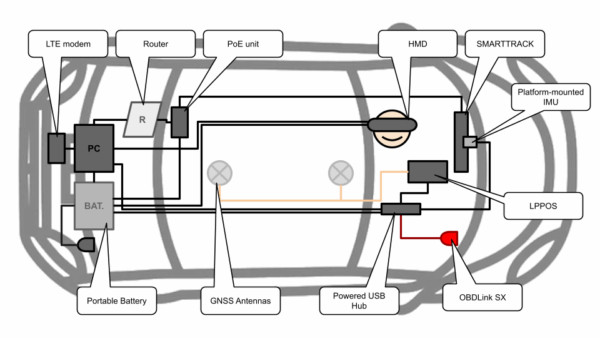
LPVR-POS: Our hardware system for acquiring knowledge about the state of the vehicle itself (wheel odometry), global localization data from GNSS (RTK-GPS), and advanced inertial measurement information from an LPMS IMU. LPPOS includes FusionHub, our sensor-fusion software for high-precision, real-time vehicle state estimation.

LPVR-DUO: Specialized sensor-fusion software that calculates the Head-Mounted Display (HMD) pose relative to the moving vehicle.

ART SMARTTRACK3: An advanced Infrared (IR) camera tracking system from our partner, Advance Realtime Tracking (ART), for precise head tracking.

IPG Automotive Stack

CarMaker Office: The simulation environment, enabled with the ViL add-on.

Movie NX: The visualization tool, enhanced with the VR add-on to create an immersive experience.

How It All Works Together

The key to this integration is a custom plugin that connects out FusionHub software with CarMaker. This plugin translates the real vehicle’s precise position and orientation (it’s “pose“) into the virtual environment.

The system workflow is a seamless loop of data capture, processing, and visualization:

Data Acquisition: LPPOS gathers vehicle data (OBD), GNSS, and IMU measurements and sends it to FusionHub. The SMARTRACK system monitors the HMD’s position, while IMUs on the headset and vehicle platform send orientation data to LPVR-DUO.

Sensor Fusion: FusionHub processes its inputs to calculate the vehicle’s exact pose in the real world. LPVR-DUO calculates the HMD’s pose relative to the moving vehicle’s interior.

Real-Time Communication: FusionHub streams the vehicle’s pose to a dedicated TCP server, which feeds the data directly into the CarMaker simulation via our custom plugin. LPVR-DUO communicates the headset’s pose to Movie NX using OpenVR, allowing the driver or engineer to naturally look around the virtual scene from inside the real car.

The entire LP-RESEARCH software stack and CarMaker Office run concurrently on a single computer inside the test vehicle, creating a compact and powerful setup.

See It in Action

We configured a scene in the CarMaker Scenario Editor that meticulously replicates our test track near the LP-RESEARCH Tokyo Office. The video on the top of this post demonstrates the fully integrated system, showcasing how the vehicle’s real-world position perfectly matches its virtual counterpart. Notice how the VR perspective shifts smoothly as the copilot moves their head inside the vehicle.

This setup vividly illustrates how VR technology makes ViL testing more immersive, effective, and even fun.

Advance Your ViL Testing Today

Are you ready to integrate cutting-edge virtual reality into your Vehicle-in-the-Loop testing and help shape the future of mobility?

Fine-tuning the HMD view and virtual vehicle reference frame is crucial for an accurate simulation and depends on the specific test vehicle and scenario. Our team has the expertise to configure these parameters for you or provide expert guidance to ensure a perfect setup.

Contact us today to learn how our tailored solutions and expert support can elevate your AD/ADAS development process.

SLAM system for AR/VR: Next-Gen Full Fusion Tracking

SLAM system for AR/VR: Next-Gen Full Fusion Tracking

At LP-Research, we have been pushing the boundaries of spatial tracking with our latest developments in Visual SLAM (Simultaneous Localization and Mapping) and sensor fusion technologies. Our new SLAM system, combined with what we call “Full Fusion,” is designed to deliver highly stable and accurate 6DoF tracking for robotics, augmented and virtual reality applications.

System Setup

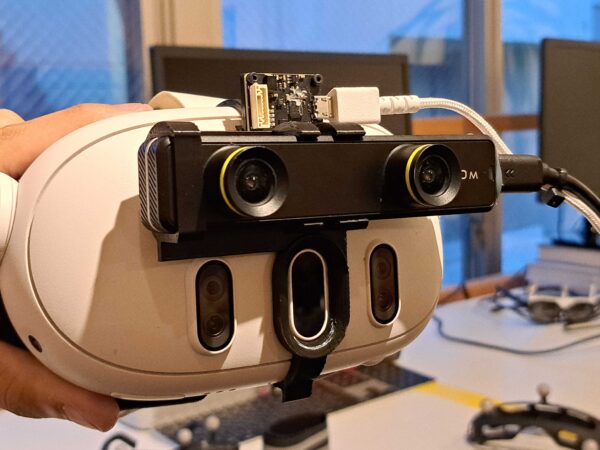
To demonstrate the progress of our development, we ran LPSLAM together with FusionHub on a host computer and forwarded the resulting pose to a Meta Quest 3 mixed reality headset for visualization using LPVR-AIR. We created a custom 3D-printed mount to affix the sensors needed for SLAM and Full Fusion, a ZED Mini stereo camera and an LPMS-CURS3 IMU sensor onto a the headset.

This mount ensures proper alignment of the sensor and camera with respect to the headset’s optical axis, which is critical for accurate fusion results. The system connects via USB and runs on a host PC that communicates wirelessly with the HMD. An image of how IMU and camera are attached to the HMD is shown below.

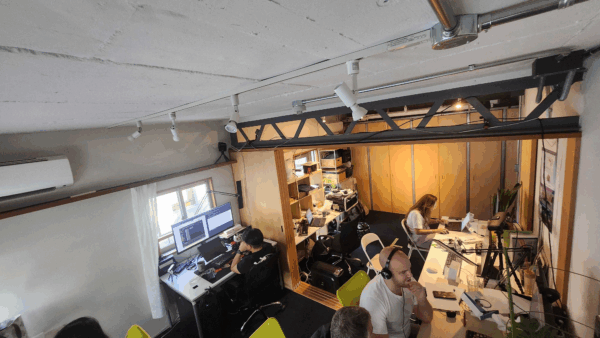
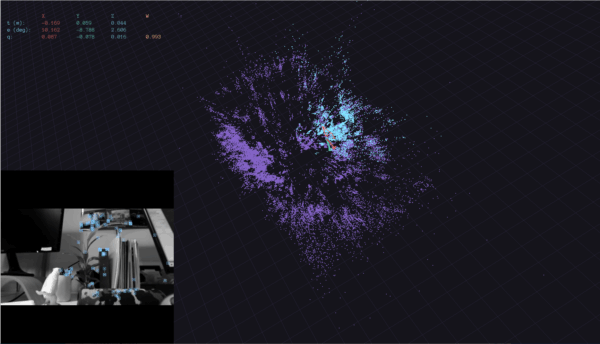
In the current state of our developments we ran tests in our laboratory. The images below show a photo of the environment next to how this environment translates into an LPSLAM map.

Tracking Across Larger Areas

A walk through the office based on a pre-built map yields good results. The fusion in this experiment is our regular IMU-optical fusion and therefore doesn’t support translation information with integrating accelerometer data. This leads to short interruptions of position tracking in certain areas where feature points aren’t found. We at least partially solve this problem with the full fusion shown in the next paragraph.

What is Full Fusion?

Traditional tracking systems rely either on Visual SLAM or IMU (Inertial Measurement Unit) data, often with one compensating for the other. Our Full Fusion approach goes beyond orientation fusion and integrates both IMU and SLAM data to estimate not just orientation but also position. This combination provides smoother, more stable tracking even in complex, dynamic environments where traditional methods tend to struggle.

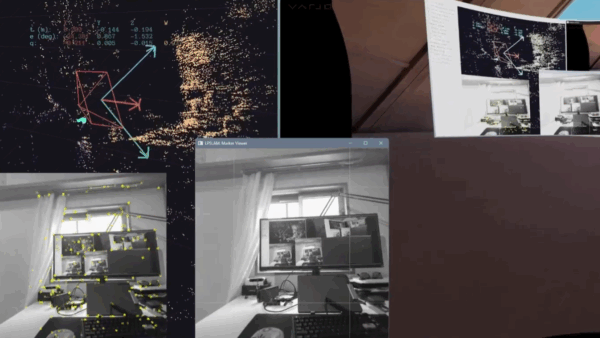
By fusing IMU velocity estimates with visual SLAM pose data through a through a specialized filter algorithm, our system handles rapid movements gracefully and removes jitter seen in pure SLAM-only tracking. The IMU handles fast short-term movements while SLAM ensures long-term positional stability. Our latest releases even support alignment using fiducial markers, allowing the virtual scene to anchor precisely to the real world. The video below shows the SLAM in conjunction with the Full Fusion.

Real-World Testing and Iteration

We’ve extensively tested this system in both lab conditions and challenging real-world environments. Our recent experiments demonstrated excellent results. By integrating our LPMS IMU sensor and running our software pipeline (LPSLAM and FusionHub), we achieved room-scale tracking with sub-centimeter accuracy and rotation errors as low as 0.45 degrees.

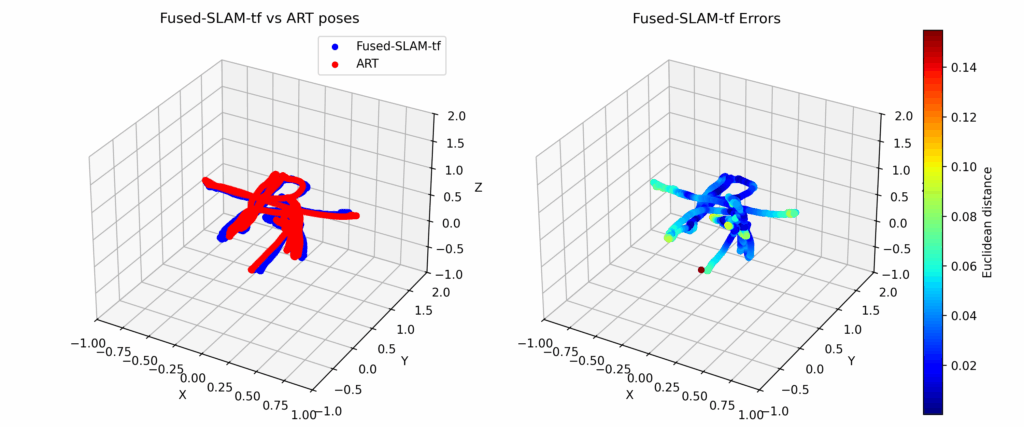
In order to evaluate the performance of the overall solution we compared the output from FusionHub with pose data recorded by an ART Smarttrack 3 tracking system. The accuracy of an ART tracking system is in the sub-mm range and therefore is sufficienty accurate to characterize the performance of our SLAM. The result of one of several measurement runs is shown in the image below. Note that both systems were alignment and timestamp synchronized to correctly compare poses.

Developer-Friendly and Cross-Platform

The LP-Research SLAM and FusionHub stack is designed for flexibility. Components can run on the PC and stream results to an HMD wirelessly, enabling rapid development and iteration. The system supports OpenXR-compatible headsets and has been tested with Meta Quest 3, Varjo XR-3, and more. Developers can also log and replay sessions for detailed tuning and offline debugging.

Looking Ahead

Our roadmap includes support for optical flow integration to improve SLAM stability further, expanded hardware compatibility, and refined UI tools for better calibration and monitoring. We’re also continuing our efforts to improve automated calibration and simplify the configuration process.

This is just the beginning. If you’re building advanced AR/VR systems and need precise, low-latency tracking that works in the real world, LP-Research’s Full Fusion system is ready to support your journey.

To learn more or get involved in our beta program, reach out to us.

Wireless Mixed Reality with LPVR-AIR 3.3 and Meta Quest

Achieving Accurate Mixed Reality Overlays

In a previous blog post we’ve shown the difficulties of precisely aligning virtual and real content using the Varjo XR-3 mixed reality headset. In spite of the Varjo XR-3 being a high quality headset and accurate tracking using LPVR-CAD we had difficulties reaching correct alignment for different angles and distances from an object. We concluded that the relatively wide distance between video passthrough cameras and the displays of the HMD causes distortions that are hard to be corrected by the Varjo HMD’s software.

Consumer virtual reality headsets like the Meta Quest 3 have only recently become equipped with video passthrough cameras and displays that operate at similar image quality as the Varjo headsets. We have therefore started to extend our LPVR-AIR wireless VR software with mixed reality capabilities. This allows us to create similar augmented reality scenarios with the Quest 3 as with the Varjo XR series HMDs.

Full MR Solution with LPVR-AIR and Meta Quest

The Quest 3 is using pancake optics that allow for a much closer distance between passthrough cameras and displays. Therefore the correction of the camera images the HMD has to apply to align virtual and real content accurately is reduced. We show this in the video above. We’re tracking the HMD using our LPVR-AIR sensor fusion and an ART Smarttrack 3 outside-in tracking system. Even though the tracking accuracy we can reach with the tracking camera placed relatively far away from the HMD is limited, we achieve a very good alignment between the virtual cube and real cardboard box, even with varying distances from the object.

This shows that using a consumer grade HMD like the Meta Quest 3 with a cost-efficient outside-in tracking solution a state-of-the-art mixed reality setup can be achieved. The fact that the Quest 3 is wirelessly connected to the rendering server adds to the ease-of-use of this solution.

The overlay accuracy of this solution is superior to all other solutions on the market that we’ve tried. Marker-based outside-in tracking guarantees long-term accuracy and repeatability, which is usually an inssue with inside-out or Lighthouse-based tracking. This functionality is supported from LPVR-AIR version 3.3.

Controller and Optical Marker Tracking

In addition to delivering high-quality mixed reality and precise wireless headset tracking, LPVR-AIR seamlessly integrates controllers tracked by the HMD’s inside-out system with objects tracked via optical targets in the outside-in tracking frame, all within a unified global frame. The video above shows this unique capability in action.

When combined with our LPVR-CAD software, LPVR-AIR enables the tracking of any number of rigid bodies within the outside-in tracking volume. This provides an intuitive solution for tracking objects such as vehicle doors, steering wheels, or other cockpit components. Outside-in optical markers are lightweight, cost-effective, and require no power supply. With camera-based outside-in tracking, all objects within the tracking volume remain continuously tracked, regardless of whether the user is looking at them. They can be positioned with millimeter accuracy and function reliably under any lighting conditions, from bright daylight to dark studio environments.

In-Car Head Tracking with LPVR-AIR

After confirming the capability of LPVR-AIR to work well with large room scale mixed reality setups, we started developing the system’s functionality to do accurate head tracking in a moving vehicle or on a simulator motion platform. For this purpose we ported the algorithm used by our LPVR-DUO solution to LPVR-AIR. With some adjustments we were able to reach a very similar performance to LPVR-DUO, this time with a wireless setup.

Whereas the video pass-through quality of the Quest and Varjo HMDs are comparable in day and night-time scenarios, the lightness and comfort of a wireless solution is a big advantage. Compatibility with all OpenVR or OpenXR compatible applications on the rendering server makes this solution a unique state-of-the art simulation and prototyping tool for autmotive and aerospace product development.

Release notes

See the release notes for LPVR-AIR 3.3 here.

1 2 3 15