
About Luis Peralta

Image Processing, CV, and SLAM: Because reality is just a very high-resolution, poorly-calibrated, and noisy video feed.

Marker-less Head Tracking with LPVISION

For our LPVIZ in-vehicle AR system we usually rely on outside-in tracking systems like the ART Smarttrack 3. These camera systems work very well and deliver almost optimum performance for the use-case, especially if they have an interference filter built-in to protect from the influence sunlight. At the same time they are relatively large and require some effort to install.

Therefore for quick and easy prototyping, we started exploring markerless head tracking as alternative to marker-based outside-in tracking. The LPVISION head pose tracker is the result: an advanced 6DOF system that uses a standard RGB camera and machine learning alorithms for accurately following the head pose of a user wearing an AR headset.
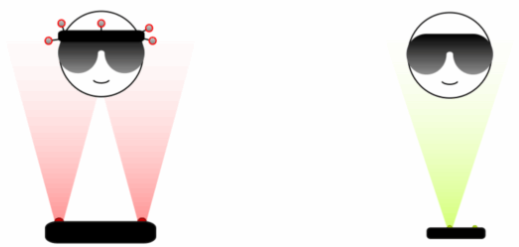
The diagram above shows the difference between marker-based (left) and marker-less (right) head tracking setups. Note that for the markerless tracking setup only a single camera and no markers attached to the headset are required.

Key Advantages

Markerless operation via facial landmark detection: The system utilizes AI-powered facial landmark detection and other computer vision techniques to track head orientation and position continuously. Because of this, there are no rigid bodies, no reflective markers, and no physical contact with tracking gear required. Ultimately, this creates a non-intrusive experience.

Single RGB camera replaces multi-camera setups: We have replaced multi-camera IR setups with a single, compact RGB camera – such as the Stereolabs ZED camera line (note that even though the ZED camera is a stereo camera we use only one of the the built-in cameras). Therefore, this dramatically reduces hardware cost and physical setup complexity, while maintaining the precision required for industrial and spatial computing applications.

Zero-contact setup and instant deployment: You can go from zero to tracking instantly. In fact, there is no room-scale calibration, no physical mounting of tracking gear on the user, and no warm-up procedure needed. Consequently, the natural user experience means deployment in the field is as simple as launching the software.

Optimal for vehicle-in-the-loop and cockpit environments: Unlike stationary IR camera arrays, this tracker is engineered for dynamic environments. Particularly, it is optimal for vehicle-in-the-loop (ViL) testing and flight cockpit applications – scenarios where traditional IR-based systems are difficult to setup due to limited space and dynamic lighting conditions.

Integration with the LPVIZ In-car AR Solution

The LPVISION head tracker is designed to act as a drop-in replacement for complex IR-based tracking setups. For users of our LPVIZ platform it is a light-weight, easy-to-install alternative to our regular proven Smarttrack 3 setup. The video below shows a test drive with the system. The tracking camera itself isn’t visible in the video. It shows the view of the camera including the detected coordinate frame on the left. The window on the right shows a simple demo scene that’s being displayed to the user wearing the headset. As the car moves foward the viewpoint in the scene moves in the same way. Direction and offset to the location of the car is controlled by the output of the markerless head tracking.

Conclusion

We successfully implemented a markerless head tracker that works with users wearing an augmented reality HMD like the Xreal Air 2 Ultra. While the solution is easy to set up and use, we were not able to reach the levels of accuracy achieved by marker-based outside-in tracking. Unsolved problems like detection failures when more than one person is in the field of view of the tracking camera remain.

In conclusion, the LPVISION head tracker system is great for prototyping and quick installations, but for applications where accuracy and reliability is essential we found that a traditional outside-in system like an ART Smarttrack 3 is the preferred solution.

We will add a quantitative comparison chart between LPVISION markerless head tracking and marker based ART tracking soon!
AD/ADAS Testing: VR-Enhanced Vehicle-in-the-Loop

The automotive industry is in a race to develop smarter, safer, and more efficient vehicles. To meet these demands, engineers rely on sophisticated development processes. At LP-RESEARCH, we’re committed to creating tools that shape the future of mobility. That’s why we’re excited to announce a groundbreaking collaboration with IPG Automotive.

By integrating our advanced hardware and software with IPG Automotive’s CarMaker, we’ve created an immersive Virtual Reality (VR) experience for Vehicle-in-the-Loop (ViL) testing. This powerful solution allows engineers to test Autonomous Driving and Advanced Driver-Assistance Systems (AD/ADAS) on a proving ground with unprecedented realism and efficiency.

What is Vehicle-in-the-Loop (ViL)?

Vehicle-in-the-Loop is a powerful testing method that blends real-world driving with virtual simulation. An AD/ADAS-equipped vehicle drives on a physical test track while interacting with a dynamic virtual environment in real time.

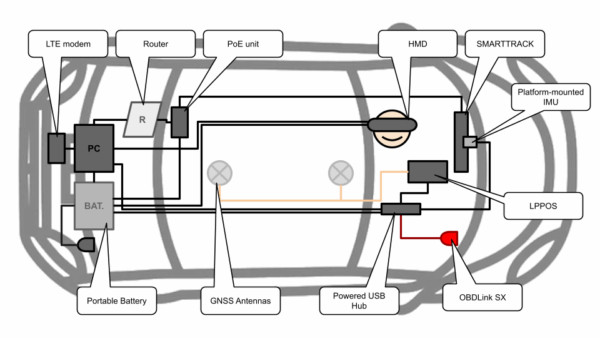
This approach lets engineers observe the vehicle’s response to countless simulated scenarios under controlled, repeatable conditions. The vehicle’s real-world dynamics are continuously fed back into the simulation, ensuring the virtual world perfectly mirrors the physical state of the car. The test vehicle is outfitted with a seamless integration of hardware and software to support this constant flow of data.

The Technology Stack: A Powerful Combination

Our collaboration combines best-in-class hardware and software from both LP-RESEARCH and IPG Automotive to deliver a complete ViL solution.

LP-RESEARCH Stack

LPVR-POS: Our hardware system for acquiring knowledge about the state of the vehicle itself (wheel odometry), global localization data from GNSS (RTK-GPS), and advanced inertial measurement information from an LPMS IMU. LPPOS includes FusionHub, our sensor-fusion software for high-precision, real-time vehicle state estimation.

LPVR-DUO: Specialized sensor-fusion software that calculates the Head-Mounted Display (HMD) pose relative to the moving vehicle.

ART SMARTTRACK3: An advanced Infrared (IR) camera tracking system from our partner, Advance Realtime Tracking (ART), for precise head tracking.

IPG Automotive Stack

CarMaker Office: The simulation environment, enabled with the ViL add-on.

Movie NX: The visualization tool, enhanced with the VR add-on to create an immersive experience.

How It All Works Together

The key to this integration is a custom plugin that connects out FusionHub software with CarMaker. This plugin translates the real vehicle’s precise position and orientation (it’s “pose“) into the virtual environment.

The system workflow is a seamless loop of data capture, processing, and visualization:

Data Acquisition: LPPOS gathers vehicle data (OBD), GNSS, and IMU measurements and sends it to FusionHub. The SMARTRACK system monitors the HMD’s position, while IMUs on the headset and vehicle platform send orientation data to LPVR-DUO.

Sensor Fusion: FusionHub processes its inputs to calculate the vehicle’s exact pose in the real world. LPVR-DUO calculates the HMD’s pose relative to the moving vehicle’s interior.

Real-Time Communication: FusionHub streams the vehicle’s pose to a dedicated TCP server, which feeds the data directly into the CarMaker simulation via our custom plugin. LPVR-DUO communicates the headset’s pose to Movie NX using OpenVR, allowing the driver or engineer to naturally look around the virtual scene from inside the real car.

The entire LP-RESEARCH software stack and CarMaker Office run concurrently on a single computer inside the test vehicle, creating a compact and powerful setup.

See It in Action

We configured a scene in the CarMaker Scenario Editor that meticulously replicates our test track near the LP-RESEARCH Tokyo Office. The video on the top of this post demonstrates the fully integrated system, showcasing how the vehicle’s real-world position perfectly matches its virtual counterpart. Notice how the VR perspective shifts smoothly as the copilot moves their head inside the vehicle.

This setup vividly illustrates how VR technology makes ViL testing more immersive, effective, and even fun.

Advance Your ViL Testing Today

Are you ready to integrate cutting-edge virtual reality into your Vehicle-in-the-Loop testing and help shape the future of mobility?

Fine-tuning the HMD view and virtual vehicle reference frame is crucial for an accurate simulation and depends on the specific test vehicle and scenario. Our team has the expertise to configure these parameters for you or provide expert guidance to ensure a perfect setup.

Contact us today to learn how our tailored solutions and expert support can elevate your AD/ADAS development process.