

What is an IMU? Inertial Measurement Units Explained
An inertial measurement unit (IMU) is an electronic sensor that measures how a body moves: its angular rate around three axes and its linear acceleration along three axes. From these measurements, and usually with the help of a magnetometer, an IMU can compute the body’s orientation in space. IMUs are the motion sense inside phones, drones, robots, vehicles, VR headsets and industrial machinery, and they are the core of every LPMS sensor LP-Research builds.
What is inside an IMU
A modern MEMS IMU combines up to three micro-machined sensors on one board:
- Gyroscope - measures angular velocity in degrees per second around the X, Y and Z axes. Integrating it over time gives the change in orientation.
- Accelerometer - measures linear acceleration in g or m/s². At rest it measures gravity, which tells the sensor which way is down.
- Magnetometer - measures the Earth’s magnetic field vector, which tells the sensor which way is north.
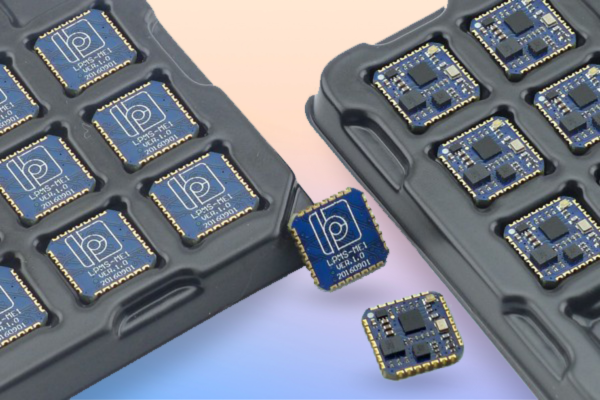
A gyroscope plus an accelerometer is a 6-axis IMU. Adding a magnetometer makes a 9-axis IMU. Many units also carry a temperature sensor for compensation and a barometric pressure sensor for altitude; the LPMS-B2, LPMS-U3 and LPMS-CURS3 include both.
IMU, AHRS, INS: what is the difference?
The terms describe how much processing happens inside the unit.
- An IMU in the strict sense delivers calibrated raw data: angular rate, acceleration and magnetic field.
- An AHRS (attitude and heading reference system) fuses those signals on board and outputs orientation directly, as Euler angles (roll, pitch, yaw) or as a quaternion.
- An INS (inertial navigation system) additionally estimates velocity and position, normally by combining the IMU with GNSS, wheel odometry or optical tracking.
Every LPMS sensor is an IMU and an AHRS in one package: a 32-bit processor inside the housing runs the sensor fusion and streams both the raw data and the fused orientation. The LPMS-IG1P adds a multi-constellation GNSS receiver and dead-reckoning algorithms, which moves it toward the INS category.
How sensor fusion turns raw data into orientation
No single sensor can measure orientation on its own. The gyroscope is fast and smooth but drifts as small errors accumulate. The accelerometer knows where down is, but only when the sensor is not accelerating. The magnetometer knows where north is, but is disturbed by nearby steel and electric currents. Sensor fusion combines the three so that the strengths of each cover the weaknesses of the others.
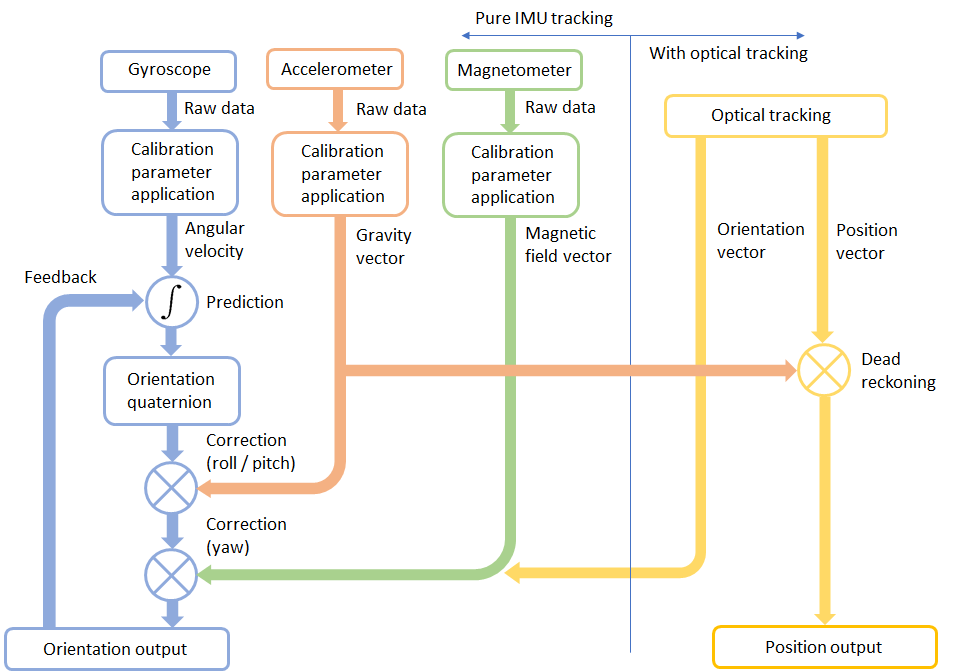
In IMUcore, the algorithm running inside all LPMS devices, the gyroscope is integrated to predict the orientation quaternion at every step. The accelerometer’s gravity vector then corrects roll and pitch, and the magnetometer’s field vector corrects yaw. The filter weights each correction by how much it can be trusted at that moment: during a strong acceleration the gravity correction is reduced, and during a magnetic disturbance the yaw correction is reduced. The result is orientation that is fast like a gyroscope and stable like a level and a compass.
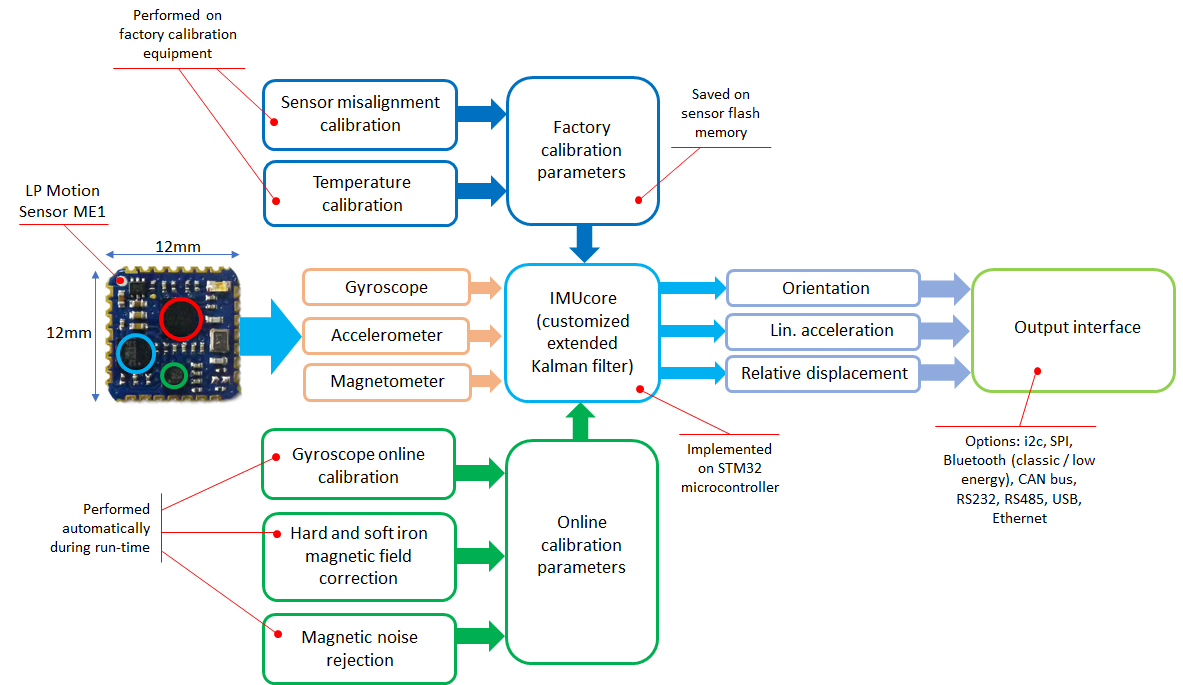
Calibration matters as much as the filter. Sensor misalignment and temperature behaviour are measured on factory equipment and stored in the sensor’s flash memory. Gyroscope bias, hard and soft iron magnetic distortion and magnetic noise rejection are handled online while the sensor runs, so the unit adapts to the environment it is mounted in.
Can an IMU measure position?
Only for a short time. Position requires integrating acceleration twice, and any bias in the accelerometer or error in the orientation estimate grows quadratically with time. Pure inertial dead reckoning on a MEMS IMU drifts by metres within seconds. For usable position an IMU is paired with an aiding source: GNSS outdoors (LPMS-IG1P), wheel odometry on vehicles and AGVs, or optical tracking indoors, as in our LPVR mixed reality systems. We wrote about the limits of pure inertial tracking in IMU-based dead reckoning revisited.
The specifications that matter
| Specification | What it tells you |
|---|---|
| Measurement range | The largest rate (°/s) and acceleration (g) the sensor can record without clipping. Fast rotations need ±2000 °/s or more; precision work benefits from a low range such as ±400 °/s. |
| Resolution | The smallest change in angle the output can represent, 0.01° on LPMS sensors. |
| Static and dynamic accuracy | Orientation error at rest and in motion, for example < 0.5° static and < 2° RMS dynamic. |
| Gyroscope noise density | Random noise per √Hz of bandwidth; lower means smoother orientation and slower drift. |
| Bias stability | How much the gyroscope’s zero point wanders over time; the key figure for heading drift. |
| Data rate and latency | How often a sample is produced and how long fusion takes. LPMS sensors sample at up to 500 Hz (1000 Hz on the LPMS-HR). |
| Output types | Raw data, Euler angles, quaternions, linear acceleration with gravity removed. |
| Interface | USB, CAN, RS232, RS485, TTL / UART, Bluetooth or Wi-Fi, and the protocol spoken on it. |
| Environmental | Operating temperature, ingress protection (IP67) and shock rating. |
IMU grades
IMUs are grouped by gyroscope performance. Consumer MEMS parts in phones and game controllers cost a few dollars and drift quickly. Industrial MEMS IMUs use better silicon, factory calibration and temperature compensation to reach noise densities around 0.002 to 0.01 °/s/√Hz; this is where the LPMS series sits. Tactical and navigation grade units use fibre-optic or ring-laser gyroscopes, weigh kilograms and cost tens of thousands of dollars, and are used where unaided navigation over minutes or hours is required.
Where IMUs are used
- Mobile robots and AGVs: heading and tilt for navigation and localization
- Automotive: vehicle dynamics testing, driver assistance validation, in-car AR / VR
- Aerospace and marine: attitude of aircraft, helicopters, ships and simulators
- Motion capture and sports science: body-worn sensors for movement analysis
- Industrial machinery: boom and platform inclination, vibration and predictive maintenance
- Virtual and augmented reality: low-latency head and controller tracking
Explore LPMS sensors
The LPMS inertial measurement unit range spans a wearable Bluetooth IMU, OEM boards, IP67 industrial units, a navigation IMU with a dedicated heading gyroscope and a GNSS-integrated unit. Read How to choose an IMU for a step-by-step selection guide, or contact us to discuss your application.